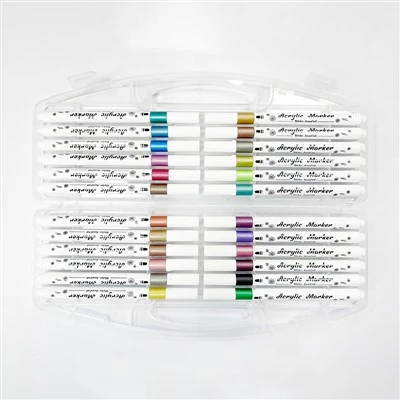
Q: What types of surfaces can Marker be used on?
A: Marker can be used on a variety of surfaces, including paper, cardboard, fabric, metal, glass, plastic, and many more.
Q: Are Markers safe to use?
A: Yes, Markers are safe to use when used according to their intended purpose. However, it is important to always read and follow the instructions on the packaging.
Q: Can Markers be used outdoors?
A: Yes, Markers can be used outdoors as long as they are labeled as waterproof or weather-resistant.
Q: How long do Markers last?
A: The lifespan of a Marker depends on several factors, such as usage, storage conditions, and the brand. However, most Markers can last for several months or even years if stored properly.
Q: Can Markers be used on food items?
A: No, Markers should not be used on food items.
Q: Can Markers be used for art projects?
A: Yes, Markers are commonly used for art projects, ranging from drawing and coloring to calligraphy and graffiti.
Q: What is the difference between water-based Markers and oil-based Markers?
A: Water-based Markers use water as the solvent, making them easy to clean up with water and less toxic. Oil-based Markers use oil or solvents as the solvent, making them more difficult to clean up but more permanent and waterproof.
Q: Can Markers be refilled?
A: Some Markers can be refilled with ink or paint, while others are disposable and cannot be refilled.
Q: How do I store Markers?
A: Markers should be stored vertically with the cap on tightly to prevent drying out and to extend their lifespan.
Q: Can Markers be used on skin?
A: Markers are not intended for use on skin, but there are special markers designed specifically for temporary body art.
Q: Can I mix different brands of Markers together?
A: Mixing different brands of Markers together is not recommended as the formulas and pigments may not be compatible, leading to uneven results or damage to the Marker.
Q: Are there eco-friendly Marker options available?
A: Yes, there are eco-friendly Marker options available that use sustainable materials and non-toxic formulas, such as recycled plastic or water-based ink.