

Single Tip vs. Dual Tip Markers: A Product Selection Guide for Buyers
For B2B buyers, the decision should consider more than tip quantity. Tip shapes, ink compatibility, product construction, color assortment, and intended applications all influence which marker design isA more suitable for a particular product line.
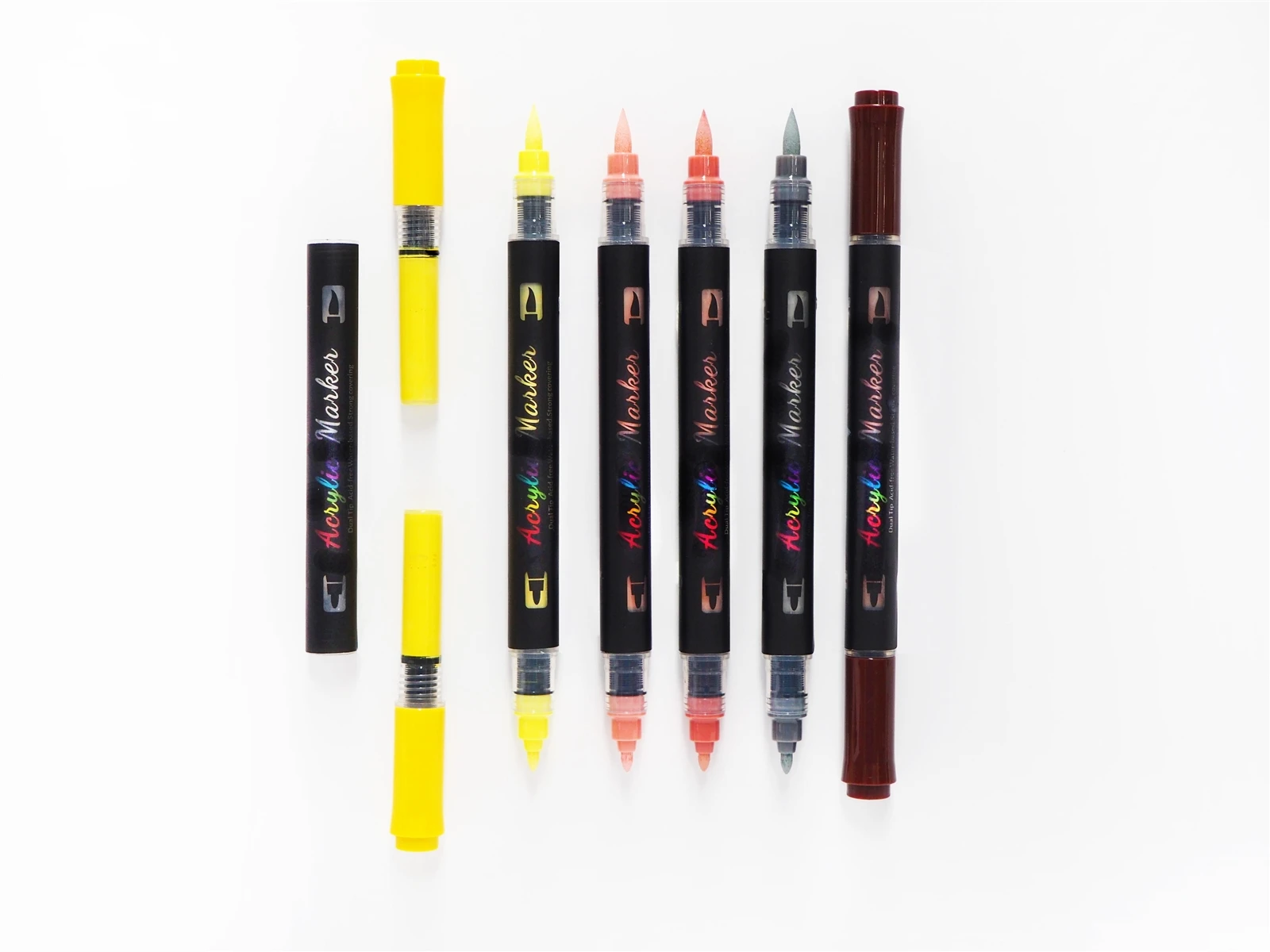
What Are Single Tip and Dual Tip Markers?
Single tip markers have one writing or drawing tip at one end of the barrel. Their design is generally straightforward, making them suitable for everyday writing, coloring, labeling, and specialized marking tasks. Depending on the model, the tip may be fine, medium, broad, or brush-shaped.
Dual tip markers feature two tips, usually at opposite ends of the barrel. The two ends may have different shapes or sizes, such as a fine tip paired with a brush tip or a broad tip paired with a narrow tip. This configuration allows users to switch between different line styles without changing pens.
For wholesalers and private label brands, single tip markers can serve focused applications, while dual tip markers can provide more functionality in one product. The better choice depends on the intended users, price positioning, and product requirements.
Single Tip vs. Dual Tip Markers: Key Specification Differences
|
Specification |
Single Tip Markers |
Dual Tip Markers |
|---|---|---|
|
Tip configuration |
One tip per marker |
Two tips per marker |
|
Writing styles |
One primary tip style |
One or two different tip styles |
|
Application range |
Focused on specific tasks |
Supports multiple line styles |
|
Product structure |
Generally simpler |
Requires a design accommodating two tips |
|
Storage and handling |
One tip to protect |
Both tips require protection |
|
Product assortment |
Suitable for task-specific collections |
Suitable for versatile creative sets |
|
Packaging considerations |
Generally straightforward |
May require additional space or tailored inserts |
|
Target applications |
Writing, labeling, basic coloring |
Illustration, lettering, coloring, creative work |
Actual performance depends on the marker design, ink formulation, tip materials, and intended use. Dual tip construction does not automatically mean better ink performance or greater durability.
Which Marker Design Is More Suitable for Different Applications?
Single tip markers are suitable when users need one consistent tip style for a specific task. Fine tip models can support detailed writing and outlining, while broader tips can be used for coloring, bold lettering, and visible markings. A focused design may also simplify product selection for buyers supplying schools, offices, or general stationery retailers.
Dual tip markers are useful for applications that require different line widths or drawing styles. For example, users can use a fine tip for outlines and small details, then switch to a brush or broad tip for shading, lettering, and larger areas. This versatility makes dual tip markers suitable for art supplies, illustration sets, journaling products, and creative stationery collections.
For B2B buyers, the key consideration is whether customers will actually use both tips. If the target market mainly needs routine writing or labeling, a single tip design may be sufficient. If customers regularly switch between detailed work and broader strokes, dual tip markers may offer greater practical value.
How Do Tip Shape and Size Affect Marker Selection?
Tip shape and size influence line width, control, ink delivery, and the types of tasks a marker can perform. Buyers should evaluate these specifications according to the intended application rather than focusing only on whether a marker has one tip or two.
Fine tips are suitable for outlines, small lettering, and detailed drawing. Medium tips provide a balance between visibility and control for general writing and coloring. Broad tips cover larger areas, while brush tips allow users to vary stroke width through changes in pressure and angle.
For dual tip markers, the combination of the two ends is particularly important. A fine-and-brush combination may suit illustration and calligraphy, while a fine-and-broad combination can support both detailed work and larger coloring areas.
When sourcing markers, buyers should confirm the actual tip type, nominal tip size where applicable, tip material, and intended use. These specifications help determine whether a product fits the expectations of the target market.
What Ink and Barrel Design Factors Should Buyers Consider?
Ink formulation and barrel construction affect the performance and usability of both single tip and dual tip markers.
The ink must be compatible with the tip material and intended surface. Water-based markers are commonly used for coloring and creative stationery, while alcohol-based markers are often selected for illustration and blending applications. Other formulations may be designed for permanent marking or specialized uses. Buyers should confirm the actual ink type rather than assuming that all markers within one design category share the same formulation.
Barrel design is also important. Single tip markers need a suitable cap and sealing structure to protect the nib from drying out. Dual tip markers must protect both ends, so cap fit and sealing performance at each end deserve attention.
For bulk purchasing, buyers should evaluate ink consistency, cap retention, tip condition, barrel durability, and product instructions. Sample testing helps identify potential issues before a larger order is placed.
How Do Single Tip and Dual Tip Markers Differ in Packaging and Cost?
Single tip markers generally have a simpler construction, which can make packaging and product assortment planning more straightforward. They are suitable for individual sales, classroom supplies, office stationery, and bulk packs where customers primarily need one tip style.
Dual tip markers combine two tip configurations in one barrel, potentially reducing the number of separate pens users need for different tasks. However, their construction may involve additional design and assembly considerations, and the actual unit cost depends on the materials, ink system, tip combination, and production requirements.
Packaging should reflect the intended sales channel. Single tip markers may be packed individually or in multipacks, while dual tip markers are often presented in sets that highlight the functions of both ends.
For wholesalers and private label buyers, comparing unit price alone is not enough. It is also useful to consider the number of markers per set, the range of functions provided, packaging costs, minimum order quantities, and the target retail price.
How Can Buyers Select the Right Marker Specifications for Their Business?
The best choice depends on the target market and intended use. Buyers serving schools, offices, or general stationery retailers may prioritize single tip markers for straightforward applications and easier product assortment planning. Businesses serving artists, designers, and creative hobbyists may consider dual tip markers to provide more drawing and lettering options in one product.
Before placing an order, buyers should confirm the following:
- Target application: Determine whether customers need one primary tip style or multiple drawing functions.
- Tip configuration: Select suitable tip shapes, sizes, and materials.
- Ink requirements: Confirm ink type, color options, and compatibility with the intended surface.
- Product construction: Review barrel design, cap sealing, and protection for each tip.
- Packaging and branding: Confirm set composition, logo printing, packaging format, and labeling requirements.
- Order conditions: Check sample availability, minimum order quantity, production lead time, and quality inspection arrangements.
Requesting samples of both designs allows buyers to compare usability, construction, and performance before committing to bulk purchasing.
Why Choose Qianxiang for Marker Products?
For stationery brands, wholesalers, and distributors, selecting a supplier involves evaluating product options, customization capabilities, and communication throughout the sourcing process.
Qianxiang supports business buyers exploring marker products for retail stationery, creative supplies, and private label projects. Buyers can discuss their target market, preferred tip configuration, color assortment, and packaging requirements to identify suitable options based on confirmed product availability.
- Product Selection Support: Compare single tip and dual tip configurations according to intended applications and customer preferences.
- Private Label Customization: Discuss available logo printing, barrel colors, color combinations, and packaging designs.
- Specification Confirmation: Review tip styles, ink options, and product construction before confirming an order.
- Sample Evaluation: Assess available samples to check tip performance, ink flow, and overall usability.
- Bulk Order Coordination: Confirm quantities, packaging requirements, and production arrangements for wholesale projects.
Whether developing a basic stationery range or a creative marker collection, Qianxiang can discuss product requirements and customization possibilities with buyers before an order is finalized.